


Commercial Fencing Options That Fit Your Site

A fence around a business property has to do more than mark a line. It has to control access, protect people and equipment, hold up in tough weather, and make sense for the budget. That is why choosing the right commercial fencing options matters from the start. The best fit depends on what your site needs every day, not just what looks good on paper.
Some properties need basic perimeter definition. Others need stronger security, better privacy, or custom access points for vehicles and staff. A warehouse yard, school, dog run, retail site, and industrial lot all have different priorities. When you look at fencing as part of how the property operates, the right material becomes much easier to choose.
How to Compare Commercial Fencing Options
The fastest way to narrow down commercial fencing options is to look at four factors first: security, privacy, maintenance, and cost. Most buyers are balancing all four, but one or two usually matter more than the others.
If security is the main concern, strength, height, gate design, and climb resistance carry more weight than appearance. If privacy matters most, the focus shifts to solid panels or slatted systems that block visibility. For high-traffic sites, durability and low maintenance often win because repairs and upkeep can become a long-term expense. Budget also matters, but the lowest upfront price is not always the lowest overall cost once repairs, lifespan, and future changes are factored in.
It also helps to think about who will use the space. A commercial property with customer traffic may need a cleaner visual finish than a fenced storage yard. A school or park may need safety-focused design choices. An industrial site may prioritize function over style. Good fence planning starts with the property use, not just the material list.
Chain Link: The Most Practical Commercial Option
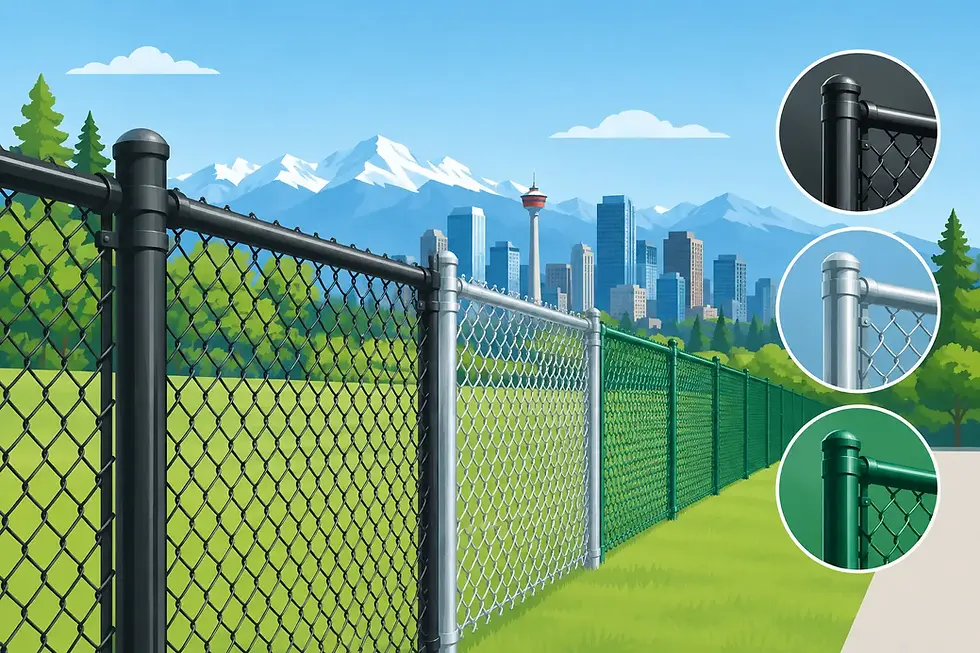
For many businesses, chain link remains the most cost-effective answer. It is one of the most popular commercial fencing options because it gives you dependable perimeter security at a price that works for both smaller properties and large-scale projects.
Chain link is a strong choice for warehouses, loading areas, equipment yards, schools, dog runs, sports spaces, and business facilities that need clear boundary control without overspending. It installs efficiently, performs well in changing weather, and can cover large areas without driving costs up the way some premium materials do.
Another advantage is flexibility. Chain link can be customized with different heights, gauges, coatings, and gate configurations. If privacy is needed, slats can be added to reduce visibility while keeping the structure practical and durable. That makes it a smart middle ground for owners who want better screening without jumping to a fully solid fence system.
It is not the best choice for every site. If appearance is a top concern for a front-facing commercial property, ornamental or vinyl styles may present a stronger visual impression. But for value, reliability, and broad commercial use, chain link is hard to beat.
Vinyl and PVC Fencing for Privacy and Clean Appearance
Vinyl and PVC fencing are often chosen when privacy and appearance matter as much as security. These materials offer a cleaner, more finished look that works well for office properties, multi-unit developments, shared-use spaces, and commercial sites that want a more polished exterior.
A key benefit is low maintenance. Unlike wood, vinyl and PVC do not need regular staining or painting. They resist moisture well and maintain a consistent appearance over time. For property managers, that can mean less ongoing work and more predictable maintenance costs.
The trade-off is usually price and impact resistance. Vinyl and PVC can be a great fit in the right setting, but for high-abuse areas or heavy industrial environments, they may not be the first choice. They are strongest when the goal is privacy, clean lines, and a low-maintenance finish rather than maximum perimeter hardening.
Ornamental Iron for Security With a Professional Look
Some commercial properties need a fence that feels more upscale without giving up strength. Ornamental iron fits that role well. It is often used for front-facing business properties, institutional buildings, and sites where curb appeal matters alongside access control.
This style creates a more open visual profile than a privacy fence, but it still establishes a strong boundary. It can also work well with custom gates and controlled entry points. For businesses that want a secure perimeter with a professional look, ornamental iron offers a good balance.
The main consideration is cost. Ornamental systems usually come at a higher price point than chain link, especially when custom design details are involved. It is often worth it for properties where appearance carries real value, but it may be more than necessary for a back lot, storage yard, or utility area.
Wood Fencing for Screening and Property Separation
Wood is still a practical option for some commercial projects, especially where screening and separation matter more than heavy-duty security. It can work well around service areas, mixed-use properties, and sites that want a more traditional look.
Wood offers solid privacy and can be built in different styles depending on the setting. It is also useful where a property owner wants to soften the appearance of a commercial space. In the right context, it gives a warmer and more natural look than metal or vinyl.
That said, wood usually requires more maintenance over time. Exposure to moisture, sun, and temperature changes can affect its lifespan and appearance. For buyers focused on long-term durability with minimal upkeep, other materials may offer better value.
Gates and Access Matter Just as Much as the Fence
A commercial fence system is only as functional as its access points. That is why gates should be part of the planning process from the beginning, not treated as an add-on at the end.
Vehicle access, pedestrian flow, security control, and equipment clearance all affect gate design. A site may need swing gates, sliding gates, double gates, or custom layouts based on how the property is used. The wrong gate setup can create daily frustrations even if the fence itself is well built.
This is especially important on busy commercial and industrial sites. Delivery schedules, staff entry, emergency access, and tenant use all need to be considered. A fence should support how the site works, not slow it down.
Choosing the Right Commercial Fencing Options for Different Properties
Different properties call for different priorities. A school may need secure boundaries and safe access points. A warehouse may care most about perimeter control and durability. A dog run needs dependable enclosure and practical function. An office property may want security without an overly industrial appearance.
That is why there is no single best answer among commercial fencing options. The right choice depends on the size of the site, the level of exposure, the need for privacy, and the budget available. In many cases, the best result comes from matching materials to zones within the same property. A chain link perimeter with privacy slats in selected areas, or an ornamental front section with more functional fencing in service zones, can provide better value than using one style everywhere.
For buyers comparing estimates, clear pricing also matters. Labor, materials, gate work, site conditions, and customization all affect the total cost. All-in pricing helps avoid surprises and makes it easier to compare real project value instead of just a low starting number.
What to Look for in a Fence Contractor
The material matters, but installation quality matters just as much. Even the right fence can underperform if the posts, alignment, gate hardware, or layout are done poorly. Commercial buyers should look for a contractor that can handle both supply and installation, explain the pros and cons of each option, and recommend solutions based on actual site use.
Experience across different project types is also a plus. A contractor who works on small business properties, larger industrial yards, schools, and custom projects is better positioned to suggest practical solutions instead of one-size-fits-all answers. That kind of experience helps when timelines are tight or the site has unique access and layout demands.
At Vallarta Fence Calgary, this practical approach is a big part of the value. Property owners and managers want competitive pricing, clear estimates, and fence systems that fit the job the first time.
The best fence for your property is the one that solves the real problem on site, stays within budget, and keeps working long after installation day. When you look at commercial fencing options through that lens, the next step is much simpler: choose the system that fits how your property actually runs.


Comments